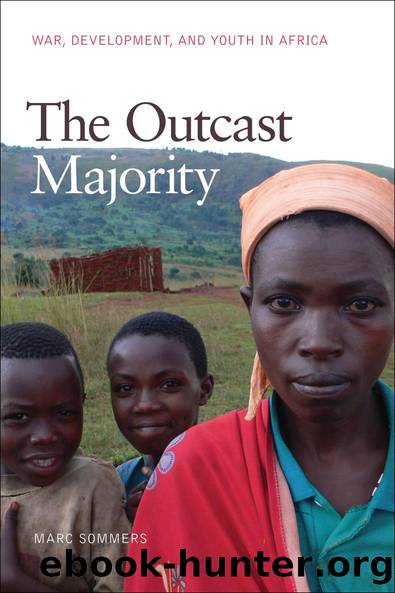
The Outcast Majority by Marc Sommers
Author:Marc Sommers [Sommers, Marc]
Language: eng
Format: epub
Tags: Social Science, Poverty & Homelessness, Political Science, World, African, Comparative Politics
ISBN: 9780820348834
Google: CwDaCgAAQBAJ
Publisher: University of Georgia Press
Published: 2015-12-01T03:42:55+00:00
Part One: Sectors and Statistics
SCRATCHING BENEATH THE SURFACE: THE INTERNATIONAL AID SETUP
Reflecting on the aftereffects of economic globalization, Stiglitz argues that âprivatization without the necessary institutional infrastructure in transition countries led to asset stripping rather than wealth creationâ (2003: 220). The case of wartime Liberia, with its weak institutional infrastructure and expert asset stripper, Liberiaâs former rebel leader and president Charles Taylor, supports this statement. During his nationâs civil war, particularly in the early and mid-1990s, Taylor absolutely thrived. He called his wartime territory âGreater Liberia,â which, at its peak, included âvirtually all of Liberia and parts of Guinea and Sierra Leoneâ (Harris 1999: 434). Indeed, it appears that Taylor accepted a reduction in the territory he ruled when he was elected as Liberiaâs president, by an overwhelming landslide, in 1997. Greater Liberia was a privatization scheme that West African scholar William Reno called âTaylorâs Shadow Stateâ (1993: 178). A very raw form of globalization flourished in Greater Liberia (popularly and appropriately known as Taylorland), where foreign firms paid Taylor for access to the regionâs diamonds, timber, rubber, and iron ore. In Taylorlandâs first five years alone (1990â1994), âthe total yields of Taylorâs warlord economy approached $200â250 million a yearâ (Reno 1998: 99).
The astonishing success of Taylorland (for Charles Taylor) obviously is not the sort of scheme that proponents of globalization and neoliberal economics have envisioned. Yet Taylorâs wholesale exploitation of Liberia during wartime is a component of todayâs global economy. Valuable raw materials routinely exit war zones and enter the global market. A popular example is eastern DRC, where neither the Congolese state nor anything approximating a regulated, formal economic sector has yet to affect the lucrative trade in what are known as âconflict mineralsâ (such as gold, wolframite, coltan, and cassiterite; see, for example, Vircoulon 2011).12 Illicit economies, in fact, may be much larger than legitimate economies in war-affected African states, among others. Nordstrom, for instance, reports that United Nations economists based in postwar Angola âestimate that over three-quarters of the [Angolan] economy runs outside of formal state and legal channelsâ (2007: 15). But she also concludes that âreputable multi-national corporations most commonly violate the laws controlling tradeâ (206), which helps explain how Charles Taylor could make a fortune before he unceremoniously exited Liberiaâs presidency in August 2003 and left his nation in a phenomenal state of ruin. Taylorâs profiteering received direct support from many economic actors. As Duffield notes, âWar economies are highly criminalized.⦠Todayâs so-called warlords or failed states may act locally, but to survive they have to think globally. In this respect, a high level of complicity among international companies, offshore banking facilities, and Northern governments has assisted the development of war economies.⦠In the early 1990s, for example, the Liberian warlord Charles Taylor . . . was supplying, among other things, a third of Franceâs tropical hardwood requirements through French companiesâ (2000: 84).
The manipulation of global capitalismâs underbelly to oneâs own ends, something Charles Taylor demonstrated not long ago, plays a small role in global debates about economic development.
Download
This site does not store any files on its server. We only index and link to content provided by other sites. Please contact the content providers to delete copyright contents if any and email us, we'll remove relevant links or contents immediately.
| Anthropology | Archaeology |
| Philosophy | Politics & Government |
| Social Sciences | Sociology |
| Women's Studies |
The Secret History by Donna Tartt(19089)
The Social Justice Warrior Handbook by Lisa De Pasquale(12190)
Thirteen Reasons Why by Jay Asher(8910)
This Is How You Lose Her by Junot Diaz(6887)
Weapons of Math Destruction by Cathy O'Neil(6281)
Zero to One by Peter Thiel(5802)
Beartown by Fredrik Backman(5754)
The Myth of the Strong Leader by Archie Brown(5508)
The Fire Next Time by James Baldwin(5446)
How Democracies Die by Steven Levitsky & Daniel Ziblatt(5219)
Promise Me, Dad by Joe Biden(5153)
Stone's Rules by Roger Stone(5088)
A Higher Loyalty: Truth, Lies, and Leadership by James Comey(4964)
100 Deadly Skills by Clint Emerson(4925)
Rise and Kill First by Ronen Bergman(4789)
Secrecy World by Jake Bernstein(4753)
The David Icke Guide to the Global Conspiracy (and how to end it) by David Icke(4720)
The Farm by Tom Rob Smith(4513)
The Doomsday Machine by Daniel Ellsberg(4490)
